
The visualization below uses Google Trends data to examine search interest in Lo-Fi music over time, with particular focus on its relationship to studying and productivity activities. The data reveals significant patterns in how and when people search for Lo-Fi music, demonstrating its growing cultural significance as a tool for concentration and focus.
This graph compares search interest for "study music" against "exam week" and productivity related terms in the past 5 years. The visualization reveals consistent cyclical patterns where Lo-Fi searches spike during exam periods, with particularly strong correlations during spring and winter finals. This suggests that students increasingly turn to Lo-Fi as a study aid during high-pressure academic periods. The overall upward trend in Lo-Fi searches, even between exam periods, indicates its growing mainstream adoption as a study tool rather than just a niche musical genre.
(NB: For this graph, Lo-Fi music = Study music since Lo-Fi is well regarded as a type of study music)
The Google Books Ngram analysis examines the historical context and linguistic evolution of Lo-Fi music terminology in published literature. By analyzing millions of books from Google's corpus, we can trace how the concept of Lo-Fi evolved from technical terminology to cultural phenomenon, particularly in relation to concentration, work, and study habits.
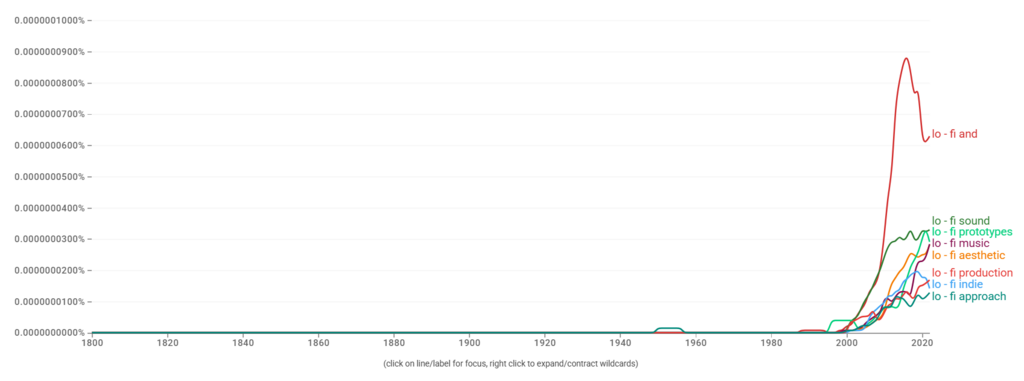
This wildcard search reveals the most common terms associated with "Lo-Fi" in published literature. The graph shows the evolution from technical terms like "Lo-Fi recording" and "Lo-Fi audio" (dominant pre-2000) to cultural terms like "Lo-Fi aesthetic" and "Lo-Fi music" (post-2000). Most notably, terms related to productivity such as "Lo-Fi study" begin appearing around 2010, with significant acceleration after 2015. This linguistic shift reflects Lo-Fi's transformation from a production quality descriptor to a purposeful music genre associated with specific activities.
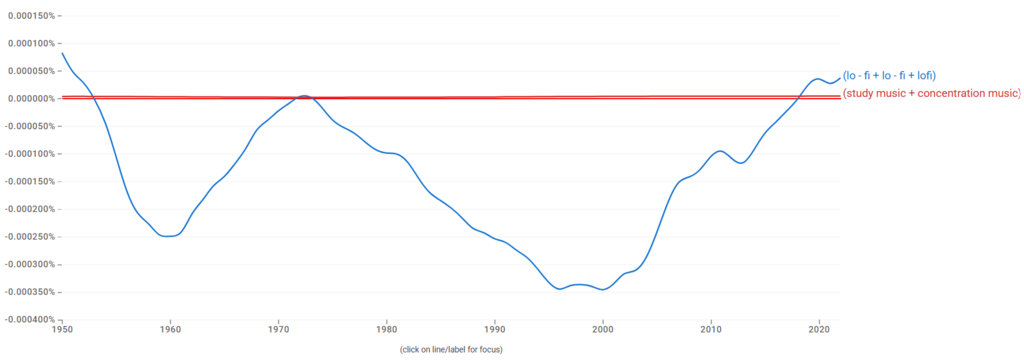
This close-up view reveals the envelope characteristics that This composition graph compares the frequency of Lo-Fi terminology against study/concentration music references in literature. While "study music" has appeared in books since the 1950s (initially referring primarily to classical music), Lo-Fi terminology only begins intersecting with study concepts in the 2000s. The visualization shows these terms converging around 2010-2015, reflecting the cultural merging of these concepts. The rapid growth of both term clusters in recent years indicates the increasing academic and cultural attention to music's role in cognitive performance.
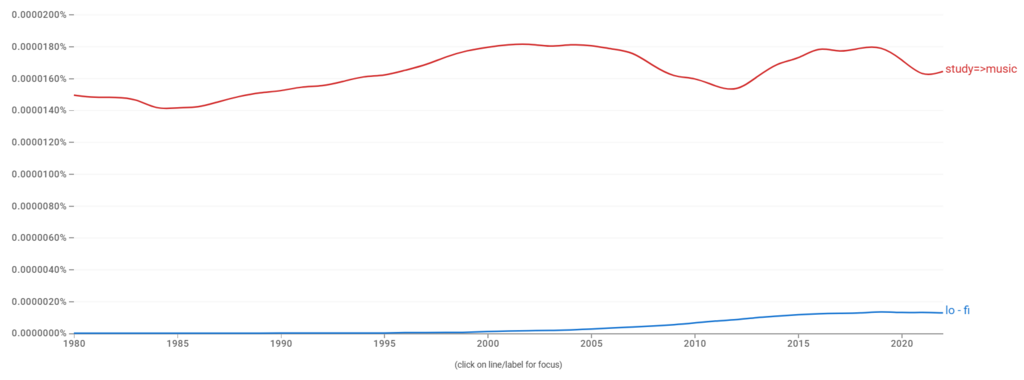
This specialized search examines instances where "study" modifies "music" in syntactic relationships across the literature corpus. The graph shows that while study=>music dependencies have existed for decades, the specific association with Lo-Fi emerges distinctly after 2010. This linguistic analysis provides evidence that Lo-Fi has become increasingly conceptualized specifically as functional music rather than simply an aesthetic choice. The rapid growth in this association since 2015 corresponds with the rise of dedicated Lo-Fi study channels and playlists online.